Saturday, September 1, 2018

Josiah Milton Warren the Cooper

My 3rd Great Uncle Josiah Milton Warren was a cooper. He made barrels. 

He was a journeyman cooper in 1870 and then in 1910 on the census his occupation was listed as cooper and the industry he was working as a cooper for was a Brewery. He lived on Bedinger Street in Ellesmere, Kenton, Kentucky.

I can find no breweries in Ellesmere in 1910 but there were three breweries in operation in Covington, Kentucky which is very near. The Covington Brewery, The New Kentucky Brewery and Bavarian Brewing 
I have no idea at which he may have worked.

Before 1910 he lived in Cincinnati, Ohio and there were 23 breweries in operation in 1910. He could have been employed by one of them.
Besides barrels, coopers also made utensils, casks, buckets, butter churns and drums, mostly things that had staves and required the skill of a hooper.
The hooper was the title of the worker who put the metal hoops around the staves to hold them together.
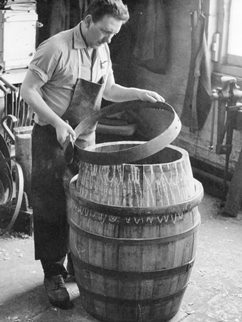
The word cooper came by way of the German word kuper from the word kupe or cask, which came from Latin cupa which was a barrel.

A slack cooper made barrels to hold dry goods such as tobacco, nails, vegetables.

A dry-tight cooper made barrels that would keep out moisture and the product inside dry. They were used for products like gunpowder.

A white cooper made buckets, butter churns,
and wash tubs, they were made to hold liquids but were not suitable for shipping items.

A wet cooper made barrels that would hold liquids tight for shipping purposes.

Seguin Moreau
is a cooperage (a factory for making barrels) that was incorporated into the House of Remy. They produce Limousin oak barrels which gives the cognac aging in them the distinct vanilla notes found in Rémy Martin Grand Cru
which sells for about $1500 a bottle making the value of the contents of each barrel a quarter of a million dollars.

What a shame he did not work there.

Josiah went by the name Milton and on 19 February 1871 her married Melissa McCormick. They had six children.

Lucetta Belle
Frederick Horatio
Clarence Sylvester
Frank Marion
Elsie L.
unknown

On 19 November 1920 Josiah passed away. 

Ansel Served on an Iron Clad

Ansel Marion Warren, my 2nd Great Grandfather served in the United States Navy.

He enlisted on April 22 1861 at the age of 19  in Pomeroy, Ohio. He was a private in Company F of the 18th Ohio Infantry he mustered out on 28 August 1861 due to an injury. 

On June 30 1863 in Marietta he enlisted and was a private in Company A of the 129th Ohio Infantry and mustered out March 8 1864 due to injuries and medial problems. 

In Cincinnati on September 2 1864 he enlisted in the United States Navy and was given the rank of Landsmen, the lowest rank given to a Naval recruit indicating no sea or boating experience.  He mustered out August 2 1865.                                                                                                                  


In his navy career...

He served aboard the USS Moose,  a wooden stern-wheel steam gunboat. She was built in 1863 in Cincinnati, Ohio and was purchased by the Union Navy. Her duty was to patrol Confederate Waterways and she prowled the Ohio River, Tennessee River, Cumberland Rivers

He also served on the USS Grampus, a side wheeled steamer. She was purchased in 1863 by the navy and named for Grampus Griseus, a member of the dolphin family known as Risso's Dolphin. She was stationed in Cincinnati, Ohio and was used to help refit and convert other ships into gunships. Her only weapons were 10  cutlasses                                                         

and revolvers and she contained no furnishings.

He served on the USS Great Western a side wheel steamer built in 1857. She was purchased by the U.S. Navy in 1862. She was an ordnance boat supplying Navy ships on the White River and the Arkansas River with ammunition and arms. 

He served on the USS Benton 


an iron clad river gunboat. She was a former center-wheel catamaran snagboat  first called submarine No.7. and had been built by the US Navy to raise sunken Steamboats under the Mississippi River.

On April 29 1863 the Benton led a fleet of 7 ironclads down the Mississippi River 


Mississippi River at Grand Gulf, Mississippi

to Grand Gulf where she was involved in the Battle of Grand Gulf.
She was pierced by a round during the fight and 25 crewman were killed. At one point in the battle the current of the Mississippi increased overwhelming her engines and the Benton was swept down stream.
She was decommissioned in July of 1865. 

Ansel married Priscilla Anderson 19 September 1867 and had 7 children.
Wellington Cashus
Hiram Marquis
James C.
Anna Martha
Sarah Viola
Emma Lee
Olive Mabel


His trade was a cooper. I had a small barrel he had made but as I was cleaning it several months ago one of the rings slipped and it fell into a heap. I could not locate a cooper to put it back together. 

By 1905 Ansel was living in Parkersburg, West Virginia and was a merchant in a retail grocery store. 

He spent the last few years of his life in the National Military Home for Veterans in Indiana

Ansel died 13 February 1935.


Alvin's 5" Leg or Cop the Bottle

Alvin Ancil Warren was born 26 May 1895 in Parkersburg, Wood County, West Virginia.  Born to  Wellington Cashus and Mary Virginia Warren  he was the oldest of 11 children. 

In 1917 Alvin was living in Parkersburg when he registered for the Draft for World War I. His card says he had blue eyes and brown hair, is short with a medium build. It also says his right leg is 5 inches shorter than his left.

His employer is listed as Essex Glass Company and he calls himself a glass worker. I was curious.
The Essex Glass Company was one of the leading glass milk bottle manufactures in the United States. In 1913 Essex Glass purchased the Standard Milk Bottle Mfg. Co. factory in Parkersburg, West Virginia. 

In 1916 Essex Glass converted the Parkersburg plant to automated machines that were manned by one person and in 1917 the new machines were operating. In 1920 The Thatcher Manufacturing Company purchased the Essex Glass Company.

Because manganese is used as a de-colorant in the manufacturing of the Essex bottle they solarize to be a pale purple. Between 1913 and 1920 Essex bottles were marked with an E4 as a logo.  These are found on the heel of the bottles.


In 1938 a patent was granted to the Gennaro Boys for a bottle design that separated the cream from the milk in the bottle while pouring the milk. Universal Glass Products Company made the bottles for the Gennaros.  

Because the stern face at the top of the bottles resembled a Police Officer


 the bottles were called Cop the Cream and the company was named 


Cop the Cream Bottle Company


The 1920 census shows that Alvin was living with the Burtons, his maternal Grandparents and he is employed as a laborer in a glass factory.


By 1926 Alvin is working at the Universal Glass Products Company in Parmaco, Parkersburg, West Virginia as an operator. Universal mostly produced milk bottles between 1920 and 1940 and in 1950 they started manufacturing liquor bottles. Their logo is UGP.

Alvin is listed as a Glazier in a 1928 Directory. A Glazier is a person who cuts, fits, installs and removes glass from windows, doors, makes table tops or mirrors.

The 1940 census says Alvin was milk bottle machine operator working in a glass factory.

In April of 1942 Alvin again was required to register for the Draft. World War II  was happening. I discovered that in 1942 Alvin's eyes are listed as brown (not blue like before), his hair is now grey, he is 5'6" tall, which is still short but here is the interesting part when it asks if there are any physical characteristics that would aid in identification of him the answer he gives is none. The mystery of this is ... Wouldn't a leg that is 5" shorter than the other be a physical characteristic for identification? How did his eyes change color? 

I turned to the next page on the site and the back of the next card says the person is 5'3" has blue eyes, brown hair and is a cripple in his right leg.  Found him!

Alvin died on 18 April 1949. His death certificate says, Cerebral Hemorrhage - fractured skull, left temporal parietal area. It is listed as an accident that occurred in a "pool room", Collapsed in pool room striking his head on the ground. 

Cigar Maker James

James C. Warren, my 2nd Great Grand Uncle is listed on the 1900 census for Lubeck, Wood County, West Virginia which is near Parkersburg as being a cigar maker. There is no further information on where or with whom as on some census. I was intrigued as to what cigar company may have been in business in Lubeck District of Wood County.

I found Marsh Wheeling Company


 in Wheeling, West Virginia. It was the oldest cigar manufacturing company in America

They were the makers of the famous Marsh Wheeling Stogies
                                   
Their cigar box became a well-known hallmark in the tobacco industry.  
                      
                                                       Augustus Pollack
Augustus Pollack Wheeling Stogies 

are another cigar company found in Wheeling. They were known for their Crown Stogies.
John Schneider & Co., Muhn & Brandfass, Brandfass Tobacco Co., H.L. Loos & Bro.Ebeling & Pebler, H. Seamon & Son and his Nail City Stogie Cigar Works, and many others.

I found cigar makers in several parts of West Virginia but only Wheeling, West Virginia is the home of Stogies.  The name comes from Conestoga wagon drivers who would buy the slim small cigars at 4 for a penny.

James was born 4 August 1874. He is the son of  Ansel Marion Warren and Priscilla his wife. 

In 1898 the Spanish-American war was happening. James enlisted in the 1st West Virginia Volunteer Infantry and was mustered in at Fort Lee on the Kanawha River across from Charleston, West Virginia in May of 1898.  The regiment was sent to Camp George Thomas in Chickamauga, Georgia. The troops remained in America and never saw action in the War. On 4 February 1899 in Columbus, Georgia the troops were mustered out. I did not find find James on the Muster Roll in Georgia I did find him in the U.S., Spanish American War Volunteers Index to Compiled Military Service Records. Several men were struck with disease during their stay at Camp Thomas, several transferred, several discharged and several more deserted. I do not know about James. 
 
He died in 1902, he was 27 and there is no more information about him. 

Tuesday, August 28, 2018

Willie and the Glacier Valdez

In 1897 headlines in all the papers screamed "Gold in Alaska!" "Valdez Glacier — Best Trail!" Gold was being discovered in the Klondike Fields

Willie, actually William Wirt French was intrigued and with his long time friend J. M. Hoagland at his side they set out for Alaska and gold. It was the summer of 1898.


William Wirt French was born 20 November 1858 in Curve, Giles County, Virginia. Curve is actually a geographical location not a village. It is located on a curve of the New River and only 2.7 miles from Pearisburg, Virginia. He is one of 10 children from Henly and Harriet French and my 1st cousin 3x removed. He attends school and helps out around the farm. 


During the 1880s Willie is 22 still living at home with his family and works as a Railroad Guard. On 6 October 1882 Willie was issued a passport. His description says he is 5'6" tall, has light brown hair and blue eyes, a small mouth and round face. 

In 1892 Willie married Rose Baach and they had 5 children.

Mildred Sue
Marion Easley
Lucille Baach
James Hoagland (named after his friend and business partner James M. Hoagland)
William Wirt Jr.

Willie was the attorney for Browning Coal and Coke Co. in Pocahontas, Tazewell County, Virginia

His office was in the St. Clair Building which housed The Block Company Groceries store also. 


On November 2 1898 Willie filed a mining claim above a canyon on Manker Creek. It was listed as claim number 7 and was named Alix. His friend J.M. Hoagland also filed a claim in the same area as claim number 8 he named Lucy. They were witness for each other. Willie was actually in possession of 60 claims. 

The rest of the legend goes a little something like this.....

In March of 1899 a group of men including Willie and his dog left from the Lake Klutina area to travel to Valdez. The Valdez Glacier lies between Lake Klutina and Valdez.  

It was the Sixth of March, a Monday and the weather seemed to be letting up, it was clear and mild. Willie along with a large group of men decided to go ahead and cross the Valdez Glacier. By Tuesday they had reached the foot of the Glacier. They made camp. Early Wednesday morning Willie and his dog set off joking with the others they would soon catch up.  He was last seen on a summit of the glacier.  A late storm sprung up Wednesday afternoon and caught Willie by surprise. He never made it to town nor back to his cabin. The rest of the group struggled through the fierce storm and upon arrival in Valdez came the knowledge that neither Willie nor his dog had made it in.  


A few days later a search party was able to go back to the trail and search for Willie. They found him on March 13 far off the trail near the summit. He had a wound under his jaw, on his head and on his left hand. He was dead.  His dog, a Saint Bernard was curled up around him and barely alive. 

On March 15 his body and his dog arrived in Valdez. He was received by the local Masonic Lodge as Willie was a Mason. They gave him a burial with full Masonic Honors on March 21.   


View of men standing in cemetery, Valdez, Alaska. From information with photo: (Gravesites)? Marked with names: Adolph Ehrhardt, N.Y., Maximillion Miller, N.Y., August G.H. Schultz, N.Y., Alfred Ellermann, N.Y., [all] died Feb. 28, 1899. W.W. French of Pocahantas, Va., died Mar. 8, 1899. Valdez, Alaska." Photo is property of Cook Inlet Historical Society. 

J.M. Hoagland took possession of the dog and had it sent to Seattle. From there the dog was sent to Willie's family in Virginia. 

Wednesday, August 22, 2018

Matthew of the 79th

Matthew Matics was born 6 September 1838 in Greenbrier County, West Virginia to Schofield and Elizabeth Matics. He was 1 of 8 children. He is my 3rd Great Uncle.

Norman Ruble, who is the Grandson of Matthew from his daughter Eleanor tells this story about Matthew. 


When Matthew was still a baby in his cradle, one of his grandmothers who smoked a pipe bent over his cradle and a hot ash dropped from her pipe and landed in the corner of his eye. The hot ash did not cause blindness, but did cause the eye to draw to the center, making Matthew cross eyed.  In a portrait owned by his grandson, Norman Ruble, the painter kept the portrait true to life by painting the eye drawn to the center.


Here is the painting. 


In June of 1861 Greenbrier County had mustered together enough men to create the 79th Regiment, Virginia Militia. Matthew was in the 4th Company under the command of Captain Andrew H. McClung. They were called to service from 3 June 1861 to 10 October 1861. 

Matthew worked as a farmer helping out on his father's farm in Greenbrier county and again when they moved to Curtis in Roane County. After the death of his parents he continued to work as a farmer. He met a young woman named Malinda Jane Hardman and married her. They had 6 children. 

Grace
Eleanor
Harry Matthew
Virginia F.
Mary Beatrice
unknown infant


By 1900 Matthew and his family are living in Tygart, Wood County, West Virginia. 


On 24 February 1901 Matthew passed away. 


Thursday, August 16, 2018

Alexander Matics

Alexander Matics was my 4th Great Grandfather. He was born in 1775 in Virginia to Schofield and Susanna Matics. He is the oldest of 7 children. 

On 17 April 1804 in Botetourt Virginia he married Eleanor Rice. They lived in Greenbrier Virginia - West Virginia and had 8 children.
Schofield
Thomas
Alexander II
John
George Washington
Matthew A.
Elizabeth
Peter

Alexander died 14 October 1840. 
In his will he leaves all the property in the house and kitchen to his wife. He gives to his only daughter, Elizabeth a 3 year old black mare and 2 cows. He leaves all his land to his son Matthew along with all his perishable property. (Perishable property, is that which, from its nature, decays in a short space of time, without reference to the care it receives. Tobacco, horses, corn etc... ) He also asks Matthew to pay his brothers $50.00 each.
Some of the items listed during the appraisal of Alexander's property include:
1 gun and shot pouch
1 clock
1 wagon
1 axe
15 sheep
5 beds
8 chairs
1 table
5 horses
3 plows

                                               Madoc of Wales tartan